Destination with a Sea View
From Marrakech to Essaouira, the sea air calls
There are departures that make no noise.
No spectacular horizon, no immediate promise. Just a city slowly fading away in the rear-view mirrors, and that particular feeling: stepping into something else.
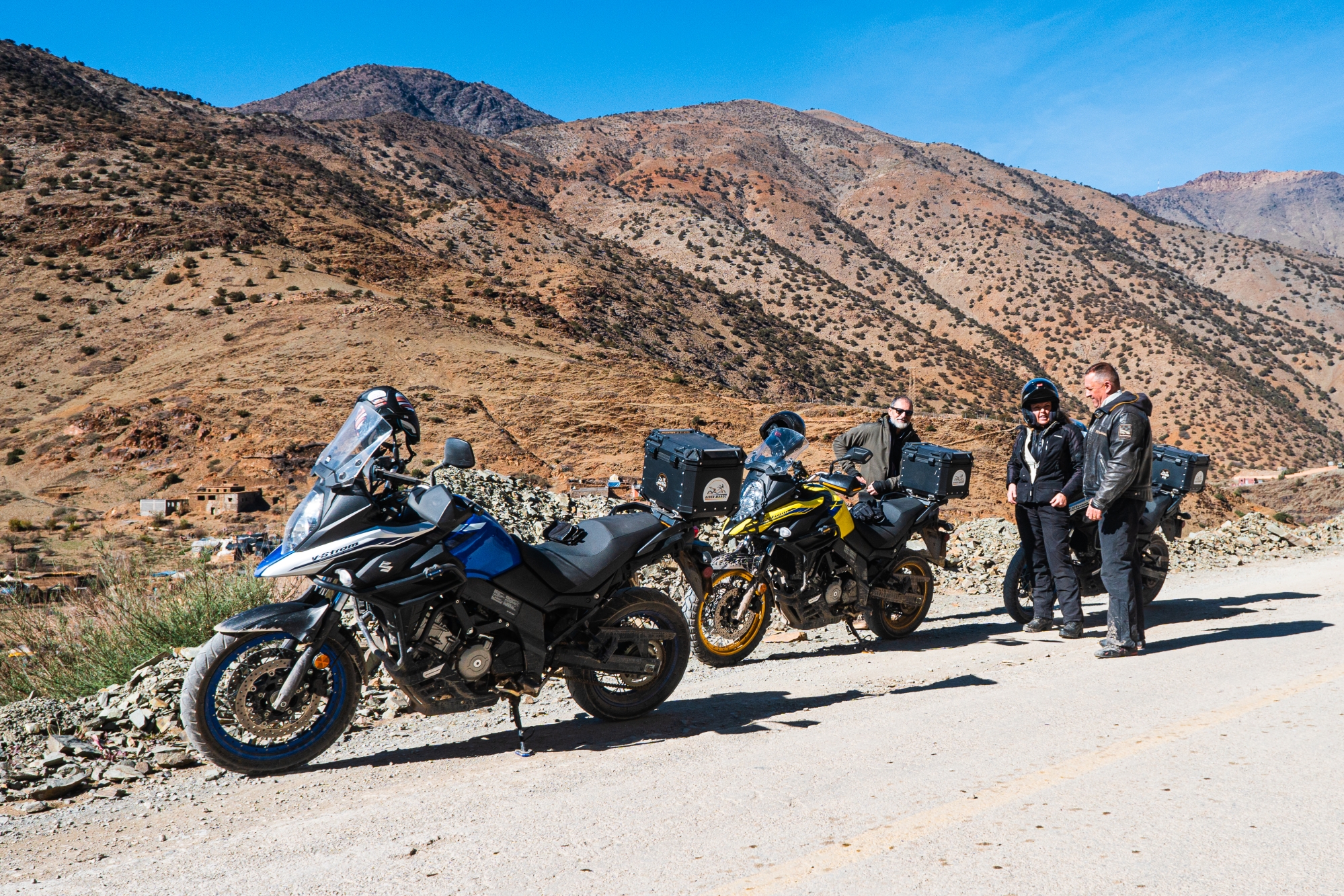
Leaving Marrakech by road means accepting a change of pace. The dry heat of the morning, the first kilometers still urban, then, without warning, space. Traffic thins out, walls disappear, and the landscape begins to speak differently. The helmet isolates just enough to hear the engine, the wind, and that gradual silence that already announces the mountains.
The road does not try to impress. It stretches out, lets itself be understood. Here, you don’t ride to arrive. You ride to cross.
Leaving the plain, entering the Atlas
The Atlas mountains do not appear abruptly. They first take shape in the distance, like a background line that slowly becomes a presence. The road begins to undulate, to climb without urgency. Villages grow more discreet, anchored to the landscape rather than imposed upon it.
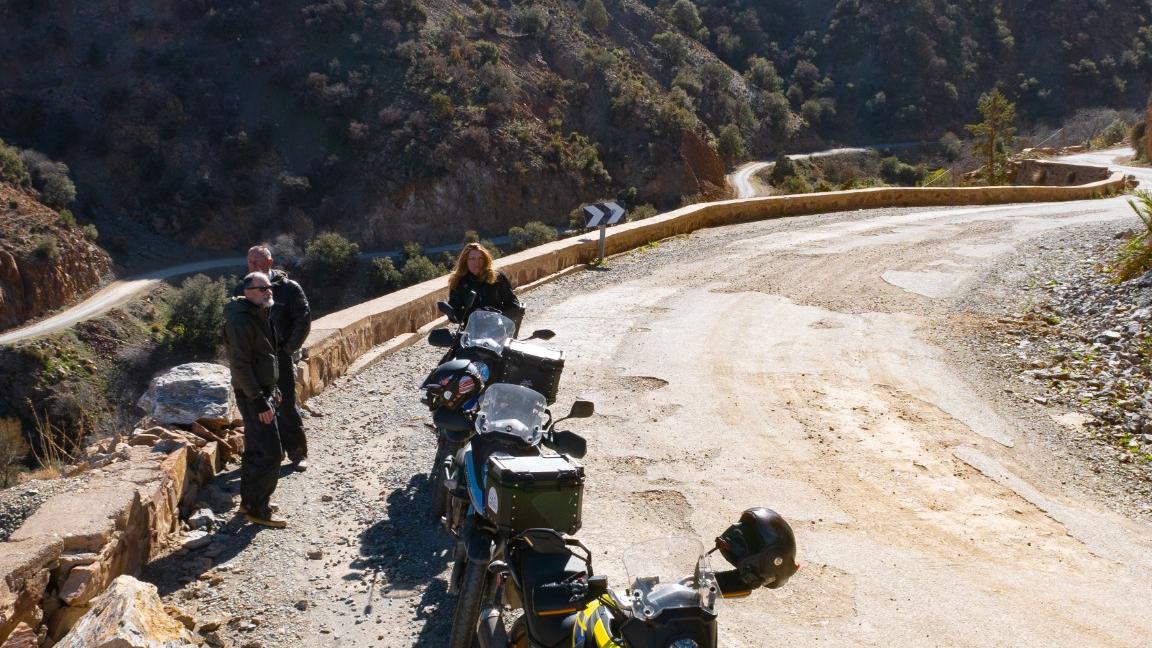
The ascent to the Tizi N’Test pass marks the first turning point of the journey. The air cools, the light becomes clearer, almost mineral. The curves follow one another not as a challenge, but as a conversation between the road and the mountain. Each bend opens a new angle, a new depth.
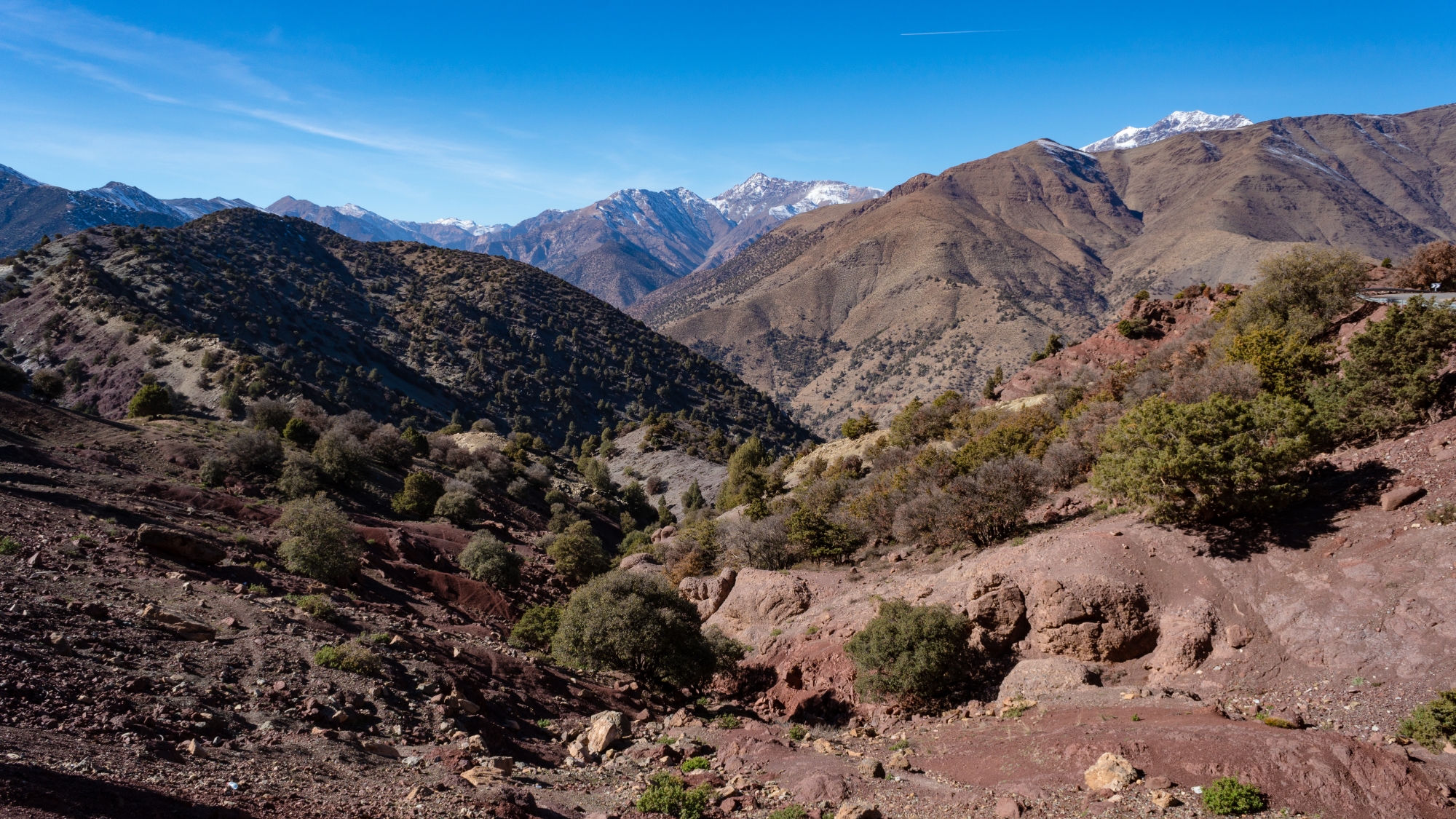
As you climb higher, Marrakech is already nothing more than a blurred memory. The gaze stretches far, over wide valleys, over slopes where rock and earth converse without artifice. Here, the Atlas does not seek to seduce. It simply imposes its presence—steady, immutable.
At the summit, time seems to slow down. At over two thousand meters above sea level, the view opens onto the Souss Valley, somewhere between the High Atlas and the Anti-Atlas. Morocco unfolds in all its verticality. It is a suspended, almost solemn moment, where one measures the privilege of being there, exactly in that precise place.
Then comes the descent. The road becomes smoother, more open. The relief softens, the mountain lets itself be left behind without regret. Ahead, Taroudant awaits.
Taroudant, inner Morocco
Taroudant is not a city you simply pass through. It imposes a natural pause. Surrounded by ramparts, protected from the bustle, it offers what few places still know how to provide: time.
Here, nothing is rushed. The narrow streets, ochre walls, and inner gardens tell the story of a more inward, more subdued Morocco. After the mountain roads, the body slows down on its own. Movements become calmer, the gaze lingers on simple details: a door, a shadow, a palm tree barely moving.
It is a place of balance. A hinge point between the heights of the Atlas and what comes next. The silence is dense, inhabited. You feel that the journey is only just beginning, even after several hours on the road.
Taroudant prepares without saying so. It anchors. It recenters.
Toward the Anti-Atlas, space opens up
Leaving Taroudant, the road changes character. The Anti-Atlas takes shape—drier, rougher. Landscapes become mineral, almost abstract. Vegetation grows sparse, giving way to powerful reliefs, sometimes austere, always fascinating.
Here, roads are narrower, more confidential. They wind through canyons, isolated palm groves, discreet dams. The kilometers stretch out in a form of beneficial solitude. Few vehicles are encountered. The world seems to have stepped aside to make room for the journey.
Time takes on another dimension. Hours pass without being counted. You ride for long stretches, without mental fatigue, carried by that rare feeling: being exactly where you are meant to be.
And then, without warning, at the turn of a bend, the air changes.
When the ocean appears
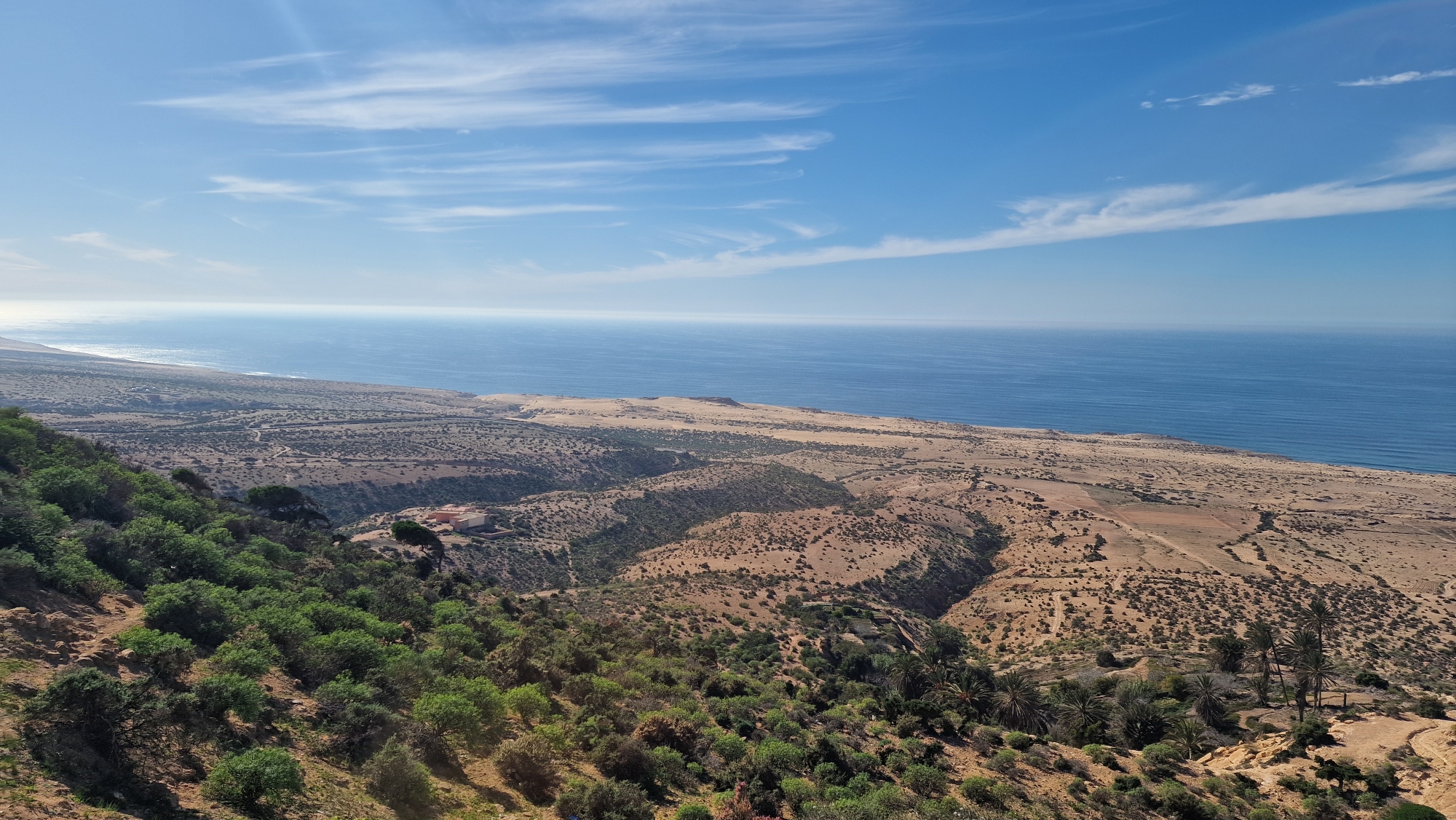
There is no announcement. No spectacular sign. Just that blue line, distant, almost unreal. The ocean appears like a revelation.
After hours of mountains and inner landscapes, the sea suddenly emerges—immense, open, undeniable. The contrast is striking. The air becomes cooler, laden with moisture and salt. The wind rises, plays with the visor, bringing with it an immediate sense of freedom.
It is a moment you never forget. One of those that leaves a lasting mark because it is unexpected. The road gently descends toward the coast, accompanied by the cry of birds and that very particular light of the Atlantic shoreline.
You are no longer quite the same as when you left Marrakech. The mountains have done their work. The ocean completes the transformation.
Taghazout, between land and sea
Taghazout is not a fixed destination. It is a link. A place where land and ocean face each other without ever opposing one another.
The village lives to the rhythm of waves, wind, and shifting light. The atmosphere is simple, almost familiar. In the evening, facing the ocean, the sun slowly sinks, setting the sky ablaze with warm tones. The sound of the waves becomes a constant, reassuring presence.
After the long roads of the Anti-Atlas, this stop offers a deep breath. You rediscover the pleasure of stopping, of watching, of listening. The fatigue is there, but it is gentle, deserved. The journey now settles into the body.
At night, if the windows are left open, the sound of the ocean accompanies sleep. Like a constant reminder: the road continues, in another way.
Along the coast, following the wind
The next day, the road hugs the shoreline. It runs alongside the Atlantic without ever trying to dominate it. The wind is omnipresent—playful, sometimes teasing. It pushes, slows, accompanies.
Imsouane appears as an unexpected interlude. The bay, wide and open, offers an almost unreal spectacle. Waves unfold with hypnotic regularity. You could believe yourself elsewhere, such is the contrast with everything that came before. Here, time seems to stretch into infinity.
The road then continues toward Sidi Kaouki. The landscape opens up even more. The horizon becomes immense. Kilometers roll by effortlessly, carried by that unmistakable Atlantic light.
This is a part of the journey where you ride less to discover than to feel. The engine becomes a simple accompaniment. What matters happens in the gaze, in the sensation of pure freedom.
Essaouira, the light before the city
Essaouira does not reveal itself immediately. It allows itself to be approached. Before the medina, before the ramparts, there is light. A white, almost vibrating light that envelops everything.
The city appears as a natural continuation after the mountains and the ocean. Neither too large nor invasive. It breathes. The wind circulates freely, clearing the air and the mind.
Here, you don’t rush through the streets. You take your time. You leave the motorcycle aside and walk. The sound of footsteps on the cobblestones, the salty smells, the muted colors of the façades tell another story of Morocco.
Essaouira has nothing to prove. It simply exists, between sky and sea. After days on the road, it offers a rare sense of calm.
The road as a human experience
This kind of crossing cannot be reduced to an itinerary. It is a human experience, made of contrasts, silences, shared moments.
Some roads are designed to go fast. Others to connect specific points. And then there are those that tell a story—those that take the time to pass through what matters most: the mountains, the land, the ocean, and what they awaken within us.
That is exactly the spirit found in certain routes, such as the RM400: a way of traveling without seeking performance, privileging sensations, landscapes, and that very particular freedom that only the road can offer.
The return, closing the loop
Leaving Essaouira to return to Marrakech means accepting that the journey is coming to an end. The road moves away from the ocean, crosses wider, almost desert-like plains. Villages grow scarcer, the landscape more stripped down.
The Agafay Desert appears as a final mineral breath. A bare, silent space that recalls, one last time, the essence of Morocco. Lake Lalla Takerkoust marks the final transition. Water, mountain, light—everything seems to echo one last time.
Reaching Marrakech, the loop closes. But something has changed. The road has left its mark. A lasting sensation, difficult to explain, yet impossible to forget.
Some journeys stay in memory long after the engine has fallen silent. This one is among them.